By

August 11, 2026
How Do I Get a UK EORI Number?
If your business imports or exports goods through the UK, you may need an EORI number before dealing with customs.
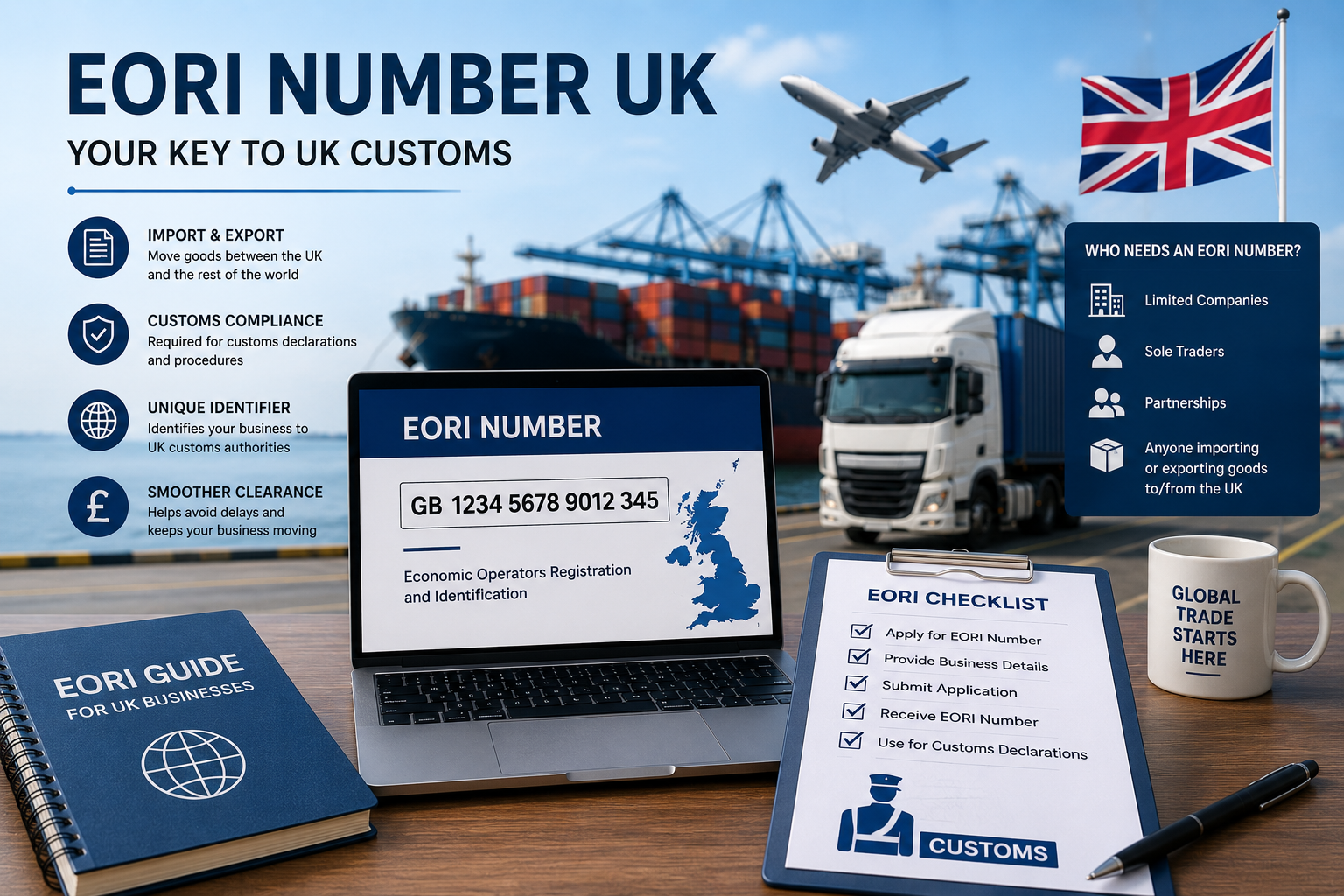
EORI stands for Economic Operators Registration and Identification. It is a unique number used by customs authorities to identify businesses and other traders involved in customs activities.
For businesses moving goods into or out of Great Britain — England, Scotland and Wales — you generally need an EORI number beginning with GB. (gov.uk)
Applying for a GB EORI is normally straightforward and can be completed online through HMRC.
You generally need a GB EORI number if you move goods between Great Britain and another country, including EU countries.
An EORI may be required when you:
For example:
UK company
↓
Orders products from China
↓
Products enter England
↓
Customs declaration required
↓
GB EORI generally needed
HMRC warns that not having the correct EORI can result in customs delays and additional costs. (gov.uk)
A Great Britain EORI begins with:
GB
followed by 12 digits.
For example:
GB123456789000
This is only an example.
If your company is VAT registered, the first nine digits of its EORI will normally correspond to its UK VAT number. (gov.uk)
You can apply online through the official HMRC service.
The basic process is:
Step 1 — Check whether you need an EORI
↓
Step 2 — Gather your business information
↓
Step 3 — Sign in or create the required sign-in details
↓
Step 4 — Complete the online EORI application
↓
Step 5 — Receive your GB EORI number
The HMRC digital registration process is designed to take around 10 minutes to complete. (gov.uk)
For a GB EORI application, HMRC says you may need information including:
For a UK limited company, the business start date and SIC code can usually be found through the Companies House register. (gov.uk)
No.
You do not need to be VAT registered simply to obtain an EORI number.
A business can therefore have:
EORI number
without having:
VAT registration
HMRC specifically confirms that VAT registration is not required to obtain an EORI. (gov.uk)
In many cases, a GB EORI number is issued immediately after the application.
If HMRC needs to carry out additional checks, it can take up to 5 working days. (gov.uk)
It is therefore sensible to apply before your first shipment is due to arrive.
You can apply directly through the official HMRC service.
Businesses should be cautious about third-party websites charging to submit an EORI application when they can use the official government application service themselves.
The rules are more complicated for businesses that are not established in the UK.
HMRC states that a business normally needs to be established in the country where it wants to import or export. However, non-established businesses can still qualify for an EORI in certain customs situations. (gov.uk)
For example, a non-established business may require an EORI where it is undertaking particular customs activities.
If the business is not eligible to obtain its own EORI for the transaction, it may need to appoint someone to deal with customs on its behalf.
The important issue is the establishment and customs position of the company, rather than simply where the director personally lives.
For example:
UK limited company
Director living overseas
Company importing goods into Great Britain
may still require a GB EORI for the company's customs activities.
The company's specific circumstances should be checked against HMRC's establishment requirements.
Generally, if your business is importing commercial goods into England, Scotland or Wales, you will need a GB EORI for the relevant customs procedures.
For example:
Chinese manufacturer
↓
Ships products to UK company
↓
Products arrive in Great Britain
↓
Customs clearance
↓
GB EORI
The same principle can apply to goods imported from the USA, EU and other overseas markets.
It depends on where the goods physically move.
For example:
UK company
↓
Chinese supplier
↓
US customer
If the goods travel directly from China to the United States and never enter the UK, there is no UK import simply because the seller operates a UK company.
A GB EORI would therefore not normally be required solely because of that transaction.
But:
China → UK warehouse
is a UK import and can require a GB EORI.
Different requirements can apply when goods move to or from Northern Ireland.
In certain circumstances, you may need an EORI beginning:
XI
HMRC states that you must first have a GB EORI before applying for an XI EORI through the UK process. (gov.uk)
Businesses trading through Northern Ireland should therefore check the specific rules for their goods movements.
No.
They serve different purposes.
Company number → identifies the company at Companies House
VAT number → identifies the business for VAT
EORI number → identifies the trader for customs
A business can therefore have all three.
Customs agents and freight forwarders can assist businesses with customs procedures.
However, businesses should understand whose EORI is being used and who is acting as the importer or exporter.
Do not automatically assume that your courier's or supplier's customs arrangements replace your company's own EORI requirements.
Once you receive your EORI, keep it with your company's customs information.
You may need to provide it to:
You should also make sure the correct EORI is used on customs declarations.
Yes.
HMRC provides an online service for checking whether a GB EORI number is valid. (gov.uk)
This can be useful before your first shipment or when providing the number to a customs agent.
Businesses should avoid:
Apply online through HMRC's official EORI application service. You will need to provide information about yourself or your business. (gov.uk)
You can apply directly using the official government service.
HMRC says a GB EORI is normally issued immediately unless additional checks are required, in which case it can take up to five working days. (gov.uk)
No. VAT registration is not required simply to obtain an EORI. (gov.uk)
If you move goods into or out of Great Britain and need to deal with customs, you will generally need a GB EORI.
Potentially, depending on its establishment and the customs activities it needs to carry out.
You may need an XI EORI for certain movements involving Northern Ireland.
Getting a UK EORI number is usually one of the first steps when preparing a business to import or export goods.
For most businesses trading through Great Britain, the process is:
Check you need an EORI
↓
Gather company and tax information
↓
Apply through HMRC
↓
Receive GB EORI
↓
Give EORI to customs agent or freight forwarder
↓
Use it on customs declarations
A GB EORI can often be issued immediately, although HMRC may take up to five working days where additional checks are required.
The safest approach is to obtain the EORI before your first international shipment is dispatched, rather than waiting until the goods reach customs.
This article provides general information only and does not constitute customs, tax, accounting or legal advice. EORI and customs requirements can change. Check current HMRC guidance for your particular business and movement of goods.