By

August 11, 2026
How Is UK Import Duty Calculated?
UK Import Duty is generally calculated by looking at what the goods are, where they originate, their customs value and the tariff rate that applies when they enter the UK.
There is no single Import Duty percentage that applies to every product.
Different goods can have different duty rates, and some goods may qualify for reduced or zero duty depending on their commodity code, country of origin and any applicable trade agreement. The UK Trade Tariff is the official tool used to find commodity codes and check applicable duty and VAT rates.
A simplified calculation is:
Customs value × applicable Customs Duty rate = Import Duty
However, determining the correct customs value and tariff rate can involve several steps.
This guide explains how UK Import Duty is calculated and what businesses should check before importing goods.
Import Duty, usually referred to as Customs Duty, is a tax that can apply when goods are imported into the UK.
The amount depends on the particular product and import transaction.
Important factors include:
The UK Trade Tariff provides the official commodity codes and applicable tariff information.
For many ordinary imports where duty is charged as a percentage of value, a simplified formula is:
Customs value × Duty rate = Customs Duty
For example:
Customs value: £10,000
Duty rate: 5%
Calculation:
£10,000 × 5% = £500
The Customs Duty would therefore be:
£500
This is only an illustration. The actual duty rate must be checked using the correct commodity code and origin of the goods.
The first important step is identifying the correct commodity code.
Commodity codes classify imported goods according to what they actually are.
The code can determine:
HMRC states that businesses need the correct commodity code so they pay the correct Customs Duty and import VAT.
Different products can attract completely different tariff treatment.
For example:
Product A → 0% duty
Product B → 4% duty
Product C → 10% duty
even if they have similar purchase prices.
The product's classification therefore needs to be established before calculating Import Duty.
Using a commodity code is effectively a declaration about the nature and duty liability of the imported goods, so incorrect classification can create customs and penalty risks.
Use the official UK Trade Tariff.
You can search using information about the product, including:
The UK Trade Tariff can then be used to check whether duty or VAT is payable and whether any reductions or suspensions apply.
The next major factor is the origin of the goods.
Country of origin does not always mean:
Country you bought the goods from
or:
Country they were shipped from.
For customs purposes, origin relates to where the goods legally originate under the relevant rules.
For example:
Goods manufactured in China
↓
Stored in Germany
↓
Sold by German supplier
↓
Imported into UK
The goods may still have Chinese origin.
Origin can affect whether the normal UK tariff rate or a preferential trade-agreement rate applies.
The UK has trade agreements and preferential tariff arrangements with various countries.
If imported goods satisfy the applicable rules of origin, a lower rate of Customs Duty — potentially even 0% — may be available.
The correct commodity code is also important when checking product-specific rules of origin.
Therefore:
Purchased from trade-agreement country
does not automatically mean:
0% duty
The goods usually need to meet the relevant origin requirements.
Preferential origin can allow goods originating in certain countries to receive reduced Customs Duty under a trade agreement.
For example:
Normal tariff rate → 8%
but:
Qualifying preferential origin → 0%
The importer generally needs appropriate evidence supporting the preferential-origin claim.
The exact requirements depend on the applicable trade agreement.
Customs Duty is usually calculated using the customs value of the imported goods.
HMRC has specific customs-valuation rules for determining this amount.
The customs value is not always simply:
Supplier invoice price
Additional amounts can sometimes need to be included.
Depending on the transaction and valuation method, the customs value can include amounts such as:
The exact calculation depends on the customs-valuation rules and the commercial arrangement.
Suppose a UK company imports products from overseas.
It pays:
Goods: £8,000
International freight: £1,000
Insurance: £200
For illustration, assume all these amounts are included in the customs value.
The customs value could therefore be:
£8,000 + £1,000 + £200 = £9,200
If the applicable Customs Duty rate were 5%:
£9,200 × 5% = £460
Potential Customs Duty:
£460
Actual valuation should always follow HMRC's applicable valuation rules.
International freight can potentially form part of the customs value.
However, the treatment depends on where the transport takes place and how the customs value is calculated.
Do not simply assume:
Product cost only × duty rate
is always correct.
For commercial imports, the freight and insurance arrangements should be reviewed alongside the supplier invoice.
Insurance costs associated with transporting the imported goods can also be relevant to customs valuation.
Again, the exact amount included depends on the applicable valuation rules.
The customs declaration should therefore reflect the correct customs value rather than merely the invoice value.
Once you have:
Commodity code
and:
Country of origin
you can use the UK Trade Tariff to identify the applicable duty treatment.
The tariff may show:
HMRC's tariff service is specifically designed to show the rates that apply when goods are imported into the UK.
Suppose:
Customs value: £25,000
Applicable duty rate: 6%
Calculation:
£25,000 × 6% = £1,500
Customs Duty:
£1,500
If the same goods instead qualified for a preferential duty rate of 0%:
£25,000 × 0% = £0
This demonstrates why origin and trade-agreement rules can significantly affect import costs.
Not necessarily.
Many products use an ad valorem tariff, meaning duty is calculated as a percentage of customs value.
However, some goods can be subject to:
Agricultural goods and certain other products can have particularly complex tariff structures.
Always check the actual tariff measure rather than assuming every duty is simply a percentage.
The UK applies its own tariff regime to imported goods.
For products that do not qualify for a preferential arrangement, the applicable non-preferential tariff rate can generally be found through the UK Trade Tariff.
The rate depends on the product's commodity classification.
Because tariff measures can change, businesses should check the live tariff when importing rather than relying on an old spreadsheet or blog post.
Yes.
Some products have a normal Customs Duty rate of 0%.
Others can qualify for 0% duty because of:
For example, the UK Trade Tariff can contain temporary duty suspensions or reductions for particular commodity codes.
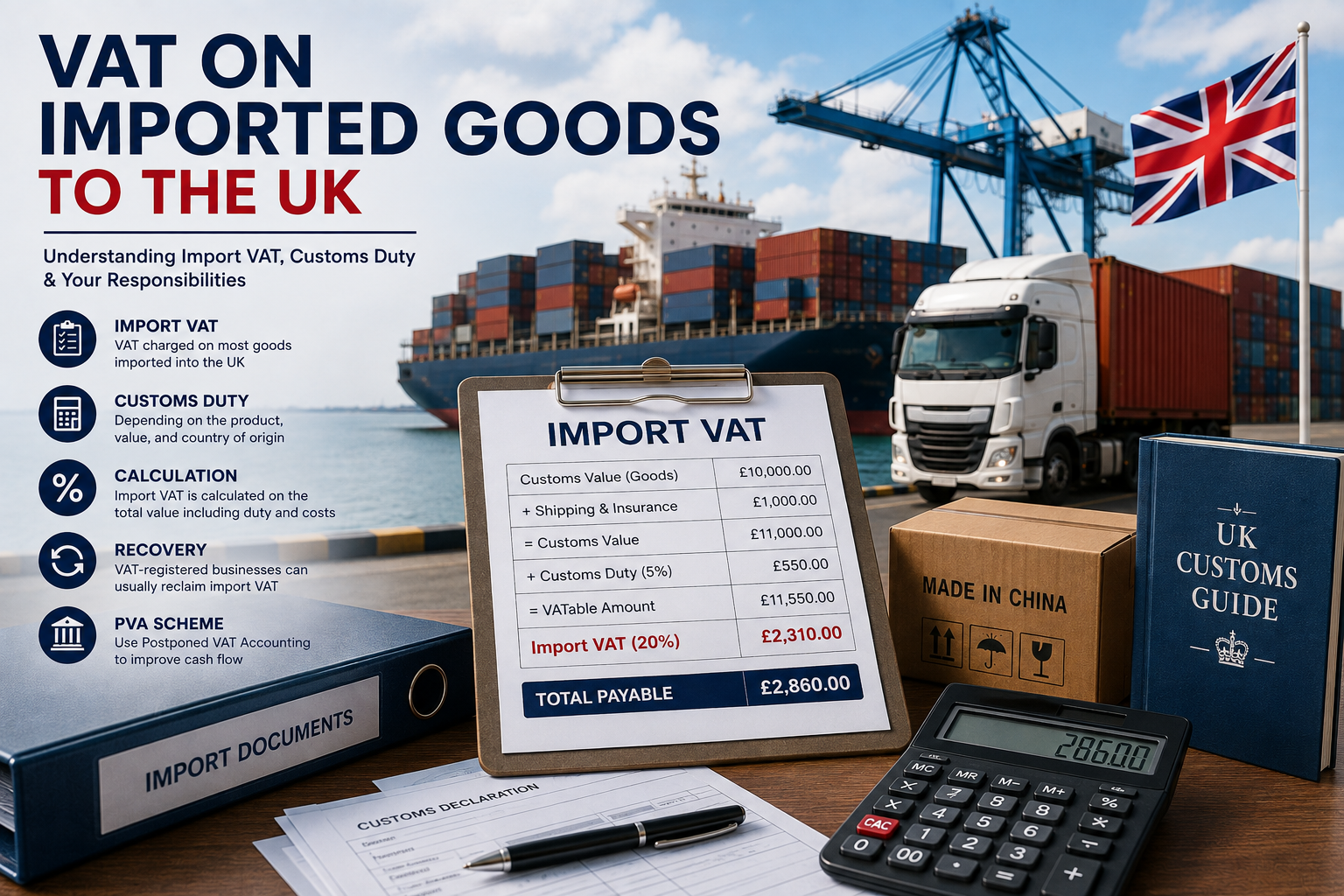
Import VAT may still apply even where Customs Duty is 0%.
No.
This is one of the most important points for importers.
A shipment can have:
Customs Duty: £0
but still have:
Import VAT
and potentially:
Excise Duty
or:
Customs clearance charges
depending on the goods.
Customs Duty and import VAT are separate.
Import VAT is calculated differently from Customs Duty.
HMRC states that the import VAT valuation starts with the customs value, even where no Customs Duty is actually payable.
Additional amounts can then be included in the VAT value according to the import VAT rules.
A simplified concept is:
Customs value
Customs Duty
Certain additional costs
↓
Import VAT value
↓
Applicable VAT rate
↓
Import VAT
The actual calculation should follow HMRC's import VAT valuation rules.
Suppose:
Customs value: £20,000
Customs Duty rate: 5%
Customs Duty:
£20,000 × 5% = £1,000
For a simplified illustration, assume the import VAT value becomes:
£21,000
If VAT applies at 20%:
£21,000 × 20% = £4,200
Potential border taxes:
Customs Duty: £1,000
Import VAT: £4,200
Total:
£5,200
This example is simplified because additional costs can affect the VAT value.
Potentially, yes.
A VAT-registered company importing goods for qualifying taxable business purposes can often recover eligible import VAT, subject to the normal VAT recovery requirements.
It may also use Postponed VAT Accounting where applicable.
This is very different from Customs Duty.
Generally, Customs Duty is not reclaimed as VAT.
It normally becomes part of the cost of importing the goods.
For example:
Customs Duty: £1,000 → business cost
Eligible Import VAT: £4,200 → potentially recoverable
This distinction should be considered when calculating product margins.
Potentially, yes.
A company importing products from China should determine:
Commodity code
↓
Chinese origin
↓
UK tariff rate
↓
Customs value
↓
Customs Duty
Some products may attract 0% duty, while others can have significantly higher rates.
There is no single “China import duty rate.”
Potentially.
The same calculation applies:
Commodity code
Country of origin
Customs value
Applicable tariff
The actual duty depends on the particular product and whether any preferential arrangements apply.
Potentially, but qualifying goods originating in the EU can potentially benefit from preferential tariff treatment under the UK-EU Trade and Cooperation Agreement.
The important word is:
originating
Simply purchasing goods from an EU supplier does not automatically prove EU origin.
The applicable rules of origin need to be satisfied.
Suppose:
French supplier
sells:
Chinese-manufactured products
to a UK company.
The products are shipped:
France → UK
The supplier being French does not automatically make the goods EU-origin.
The appropriate origin rules must be applied.
Customs Duty could therefore still be payable depending on the product and circumstances.
A tariff-rate quota can allow a specified amount of a particular product to be imported at:
Lower duty
or:
0% duty
Once the quota is exhausted, a higher rate may apply.
Quota rules can be product- and origin-specific.
The UK Trade Tariff should be checked when a quota might apply.
Certain imports can face additional trade-remedy duties.
These can include:
These charges are designed to address particular trade practices or import surges.
HMRC notes that its general tariff lookup information does not always provide the full detail of trade-remedy measures, so importers should check the relevant tariff measures carefully.
Yes.
Trade-remedy duties can sometimes be substantially higher than the ordinary tariff rate.
For some goods, these additional duties can dramatically change whether importing is commercially viable.
Importers should check for trade-remedy measures before placing a large supplier order.
Commodity codes identify products at a detailed level.
For imports into the UK, the declaration can require a detailed tariff classification.
For example, the exact code could differ based on:
material
function
construction
size
or:
intended use
Two visually similar products may therefore have different commodity codes and duty rates.
Incorrect classification can lead to:
HMRC notes that commodity codes are a core determinant of duty liability and import requirements.
Businesses importing significant volumes should take classification seriously.
Businesses can use the UK Trade Tariff and HMRC guidance to classify products.
For difficult or high-value imports, formal classification or valuation options may also be available.
Importers should retain sufficient product information to justify the classification used.
HMRC offers an Advance Valuation Ruling Service that can provide legal certainty about the customs valuation method to use for imported goods.
This can be particularly useful for businesses with complicated transactions involving:
Often the calculation is handled as part of the customs declaration.
This may be prepared by:
However, using a customs agent does not mean the importer should ignore the calculation.
You should still check that the declaration uses the correct:
Commodity code
Origin
Customs value
and:
Tariff treatment
Couriers can handle customs clearance and calculate duties based on the information provided.
However, the importer should verify that:
Incorrect supplier information can result in incorrect customs charges.
No.
A courier may charge a separate:
Customs clearance fee
Administration fee
or:
Disbursement fee
These are not necessarily Customs Duty.
For example, an invoice might contain:
Customs Duty: £500
Import VAT: £2,100
Courier clearance charge: £40
These should be distinguished in your accounting records.
Potentially.
Commercial terms such as:
EXW
FOB
CIF
DAP
and:
DDP
can affect:
However, Incoterms do not simply change the legal tariff rate.
The correct customs valuation and import responsibilities still need to be determined.
Delivered Duty Paid generally means the seller takes responsibility for delivering the goods with applicable import formalities and duties dealt with under the agreed arrangement.
For a UK buyer, DDP can appear convenient.
However, confirm:
Who is importer of record?
and:
Whose VAT/EORI information is being used?
This can affect the buyer's ability to recover import VAT.
Import Duty should be included when calculating your landed cost.
A simplified landed-cost calculation might include:
Product cost
International freight
Insurance
Customs Duty
Non-recoverable import taxes
Customs clearance
Domestic delivery
=
Landed cost
For ecommerce and retail businesses, landed cost is more useful than simply looking at the supplier's unit price.
Suppose:
Goods: £10,000
International freight: £1,000
Customs Duty: £550
Customs clearance: £100
UK delivery: £300
Assuming import VAT is fully recoverable and therefore excluded from long-term cost:
Landed cost = £11,950
This figure gives a more realistic basis for determining product margins.
Yes.
Import costs should ideally be estimated before committing to a supplier order.
Before purchasing, determine:
Commodity code
↓
Origin
↓
Tariff rate
↓
Estimated customs value
↓
Customs Duty
↓
Import VAT
↓
Freight
↓
Clearance costs
↓
Total landed cost
A product that appears inexpensive from an overseas supplier can become considerably more expensive after import costs are included.
Before importing goods, check:
What exactly is the product?
What is its commodity code?
Where do the goods originate?
Is preferential origin available?
Do I have the required origin evidence?
What is the customs value?
What duty rate applies?
Is there a tariff suspension?
Does a quota apply?
Are there anti-dumping or other trade-remedy duties?
What import VAT will arise?
Is the import VAT recoverable?
Who is acting as importer?
What are the total landed costs?
UK importers should avoid:
For many products, Customs Duty is calculated by multiplying the customs value by the applicable duty rate. The rate is determined using the product's commodity code, origin and current UK Trade Tariff.
The rate can depend on commodity classification, country of origin, trade agreements, quotas, tariff suspensions and other customs measures.
Not necessarily. Customs Duty is generally based on the customs value, which can include additional amounts such as certain freight, insurance and other costs.
Certain transport costs can form part of the customs valuation depending on the applicable valuation rules.
No. Customs Duty and import VAT are separate taxes.
Customs Duty is generally not recoverable as VAT and normally forms part of the company's import cost.
Potentially, where it is VAT registered, entitled to VAT recovery and has the correct import evidence.
No. Some products have a 0% tariff or may qualify for preferential or suspended rates.
Qualifying EU-origin goods can potentially receive preferential treatment under the UK-EU trade agreement, but the relevant rules of origin must be met.
Use the official UK Trade Tariff to find the commodity code and current duty treatment.
So, how is UK Import Duty calculated?
For many ordinary imports, the process is:
Identify the product
↓
Find the commodity code
↓
Determine country of origin
↓
Check whether preferential treatment applies
↓
Calculate the customs value
↓
Find the current tariff rate
↓
Customs value × duty rate
↓
Customs Duty due
Then calculate any separate:
Import VAT
Trade-remedy duties
Excise Duty
Courier or customs-clearance charges
The most important mistake to avoid is assuming that UK Import Duty is simply a fixed percentage added to the supplier's invoice.
It is not.
The correct calculation depends on:
Commodity code + origin + customs value + current tariff treatment
For regular importers, calculating the total landed cost before purchasing stock can be just as important as calculating Customs Duty itself.
This article provides general information only and does not constitute customs, tax, accounting, financial or legal advice. Commodity codes, tariff rates, trade agreements and customs measures can change. Always check the current UK Trade Tariff and HMRC guidance for the specific goods being imported.