By

August 11, 2026
What Is an EORI Number and Do I Need One?
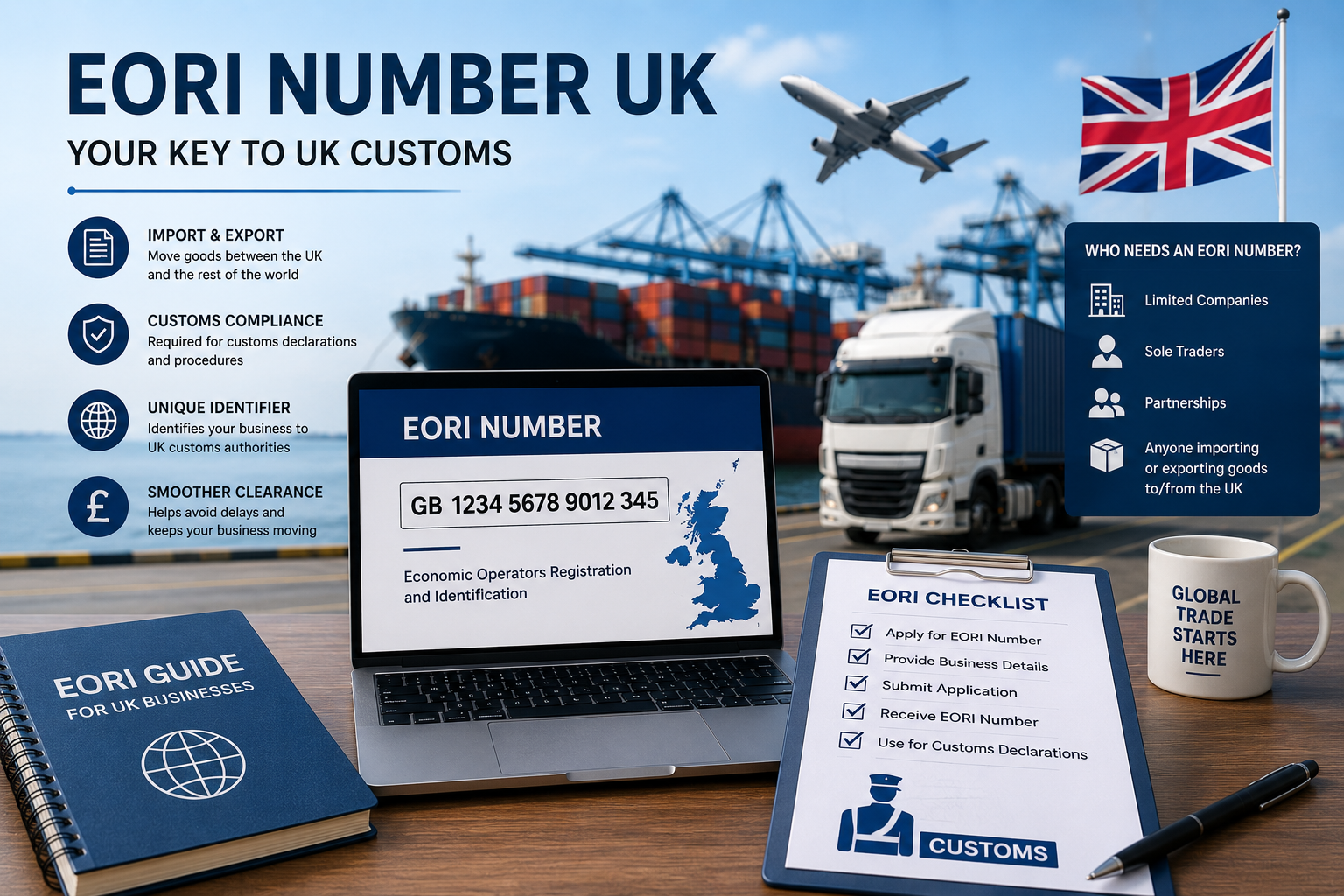
An EORI number is an Economic Operators Registration and Identification number used to identify businesses and individuals when dealing with customs.
If your business imports goods into or exports goods from the UK, you may need an EORI number to complete customs procedures.
An EORI number is not the same as a VAT number or company registration number.
In simple terms:
Moving goods across a customs border
↓
Customs declaration may be required
↓
EORI number identifies the trader
This guide explains what an EORI number is, who needs one and how it works for UK businesses.
EORI stands for:
Economic Operators Registration and Identification
It is a unique customs identification number.
Customs authorities use EORI numbers to identify businesses involved in importing and exporting goods.
An EORI number can be required when dealing with customs activities such as:
Your freight forwarder, courier or customs agent may ask for your EORI number before clearing a commercial shipment.
You will generally need an appropriate EORI number if your business moves goods between Great Britain and other countries and needs to interact with customs.
For example:
Chinese supplier
↓
Goods shipped to UK company
↓
Goods enter Great Britain
↓
Customs clearance
↓
EORI number generally required
However, the exact requirement depends on where the goods are moving and who is responsible for the customs declaration.
An EORI number used for customs activities in Great Britain generally begins with:
GB
It is followed by a series of numbers.
For example:
GB123456789000
This is only an illustration.
Never use an example number for an actual customs declaration.
No.
They serve different purposes.
Identifies a business for VAT purposes.
Identifies a business for customs purposes.
A business can therefore have:
VAT registration number
and
EORI number
at the same time.
Do not assume VAT registration automatically means your customs arrangements are complete.
No.
A Companies House registration number identifies the legal company.
An EORI number identifies the trader for customs purposes.
For example:
Company number → Companies House
VAT number → VAT
EORI number → Customs
Each number has a different purpose.
If your UK business imports commercial goods from China into Great Britain, it will generally need an appropriate EORI number where it is acting as the importer and completing customs procedures.
For example:
UK Ltd buys products from China
↓
Products shipped to UK
↓
UK Ltd acts as importer
↓
GB EORI generally required
The company should arrange its EORI before the shipment reaches customs.
The same general principle applies.
If a UK business imports goods from the United States into Great Britain and needs to make customs declarations, it will generally need an appropriate EORI number.
The requirement is based on the customs movement rather than the supplier being located in a particular country.
Businesses moving goods between Great Britain and EU countries can also require an EORI number because customs procedures apply to these movements.
For example:
French supplier
↓
Goods shipped to England
↓
UK customs import
↓
EORI may be required
Special rules can apply to movements involving Northern Ireland.
Northern Ireland has particular customs arrangements.
Depending on the movement of goods, a business may need an EORI number beginning with:
XI
rather than, or in addition to, a GB EORI.
The correct requirement depends on:
Businesses trading through Northern Ireland should check the current HMRC requirements for the specific movement.
Potentially, yes.
A UK business exporting commercial goods from Great Britain can need a GB EORI number for customs declarations.
For example:
UK company
↓
Exports products to USA
↓
UK export declaration
↓
GB EORI generally required
The destination country may also have its own import-registration requirements for the customer or importer.
Usually not simply because you sell services internationally.
EORI numbers primarily relate to customs procedures involving goods.
For example:
UK consultancy sells advice to US client
generally does not require an EORI simply because the customer is overseas.
But:
UK company exports physical equipment to US client
may require customs procedures and an EORI number.
Potentially, yes.
An ecommerce business importing stock into the UK may need an EORI number.
For example:
UK ecommerce company
↓
Orders 1,000 products from overseas
↓
Stock enters UK warehouse
↓
Customs declaration
↓
EORI generally required
This can apply whether the products are sold through:
The sales platform itself does not determine whether an EORI is required.
Dropshipping can be different because the goods may never enter the UK.
For example:
UK company
↓
Chinese supplier
↓
Ships directly to US customer
The goods do not enter the UK.
A UK import EORI would therefore not normally be required merely because the seller is a UK company.
However, customs requirements may arise in the country where the goods actually enter.
Follow the physical movement of the goods.
Potentially, yes.
Using:
does not necessarily remove the need for your business to have an EORI.
The agent may make the declaration for you, but it may still need your EORI number if your business is the importer or exporter.
Do not assume this is appropriate.
Whether an agent acts directly or indirectly and whose EORI appears on a declaration can have legal and tax consequences.
Your customs agent should use the correct details for the particular transaction.
Businesses should know who is acting as:
Importer
and
Declarant
before goods are shipped.
Not necessarily.
VAT registration and EORI registration are separate.
A business may need an EORI number even if it is not VAT registered.
This is particularly relevant to smaller businesses importing goods before reaching the applicable VAT registration requirements.
For VAT-registered importers, correct customs information is important when accounting for and reclaiming Import VAT.
If your EORI or VAT information is incorrectly entered on customs declarations, this can create problems with:
Businesses should therefore check customs declarations rather than automatically assuming their agent used the correct information.
UK businesses can apply through the official government service.
You may need information about:
The information required depends on the type of applicant.
Always use the official GOV.UK application process rather than paying an unnecessary third party simply to submit a straightforward application.
Processing times can change.
If you know your business will shortly begin importing or exporting, apply before your first shipment.
Do not wait until:
Goods arrive at UK border
to discover that the customs agent requires an EORI.
Missing customs information can delay clearance.
An EORI number is intended to identify the trader for customs purposes and is not something businesses normally reapply for every year.
However, businesses should keep their registration details accurate and check the current HMRC requirements if their legal structure or customs circumstances change.
Yes.
If your company has previously imported or exported goods, check your:
Do not apply repeatedly for new numbers simply because you cannot immediately find the previous one.
If an EORI is required but you do not have one, your customs declaration may not be processed correctly.
This can potentially lead to:
For commercial importers, it is best to resolve EORI requirements before shipping.
Before importing or exporting goods, check:
Where are the goods moving from?
Where are they moving to?
Who is the importer?
Who is the exporter?
Is a customs declaration required?
Do I need a GB EORI?
Do Northern Ireland rules apply?
Is the correct EORI on the declaration?
Is my VAT information correct?
Has my customs agent received the correct details?
Businesses should avoid:
An EORI is an Economic Operators Registration and Identification number used to identify businesses and individuals for customs purposes.
A UK company will generally need an appropriate EORI if it imports or exports goods and needs to interact with UK customs.
An EORI used for customs activities in Great Britain generally begins with GB.
No. VAT numbers are used for VAT purposes, while EORI numbers are used for customs identification.
Generally, yes, if your business is importing goods into Great Britain and is responsible for the relevant customs procedures.
Potentially, yes. Goods moving between Great Britain and the EU are subject to customs procedures.
Generally not simply for supplying services because EORI numbers primarily relate to customs procedures involving goods.
It depends on the movement of the goods and who acts as importer. If goods never enter the UK, a UK import EORI may not be required for that transaction.
Yes, depending on your circumstances. VAT registration is not a universal prerequisite for needing an EORI.
So, what is an EORI number and do you need one?
An EORI number is essentially your business's identification number for customs.
If your UK business is:
Importing goods into the UK
or
Exporting goods from the UK
you may need an appropriate EORI number.
For businesses trading through Great Britain, this will commonly be a:
GB EORI number
Different requirements can apply to certain Northern Ireland movements.
The key distinction is:
Company number → identifies your company
VAT number → identifies your VAT registration
EORI number → identifies you for customs
If you plan to import or export physical goods, check your EORI requirements before the first shipment leaves the supplier. This can help avoid unnecessary customs delays and storage charges.
This article provides general information only and does not constitute customs, tax, accounting or legal advice. EORI and customs requirements can change, particularly for different UK territories and movements of goods. Always check current HMRC guidance for your specific transaction.